

Mumbai humidity tests more than the sensing element: condensation, salt deposits, connector leakage, corrosion and temperature-driven drift can damage accuracy before a transducer stops producing an output. You will be able to compare environmental evidence, construction details, installation controls and maintenance records, then select a candidate on documented performance rather than the fluxgate label alone.
Key takeaways
- Choose from environmental test records, not sensing principle alone.
- Check condensation control, salt protection, corrosion resistance, and insulation leakage paths.
- Compare an AIT fluxgate transducer against isolation, drift, bandwidth, and thermal performance.
- Inspect seals, connectors, mounting, and calibration stability before monsoon exposure.
Humidity performance depends on the complete environmental design
A precision current transducer for humid conditions in Mumbai needs complete environmental design; no sensing principle, including fluxgate technology, identifies the best choice alone. Condensation forms when equipment falls below the dew point, while chloride-bearing salt deposits increase surface leakage and accelerate corrosion.
These stresses create distinct failure paths. Moisture on circuit surfaces and connector leakage can cause zero drift, noise and reduced insulation resistance; corroded terminals, degraded cable joints and temperature-induced offset can change gain, linearity and calibration stability before the output fails completely.
For precision current transducer humidity performance, demand evidence covering:
- Operating temperature and relative-humidity limits
- Whether the limits are non-condensing or condensing
- Storage humidity and temperature
- The insulation system, creepage and clearance design
- Connector and cable-entry sealing
- Accuracy data after humidity exposure
Ask for zero error, gain error, linearity, noise and calibration drift at the stated current, temperature and supply conditions. A stated 95% RH limit does not prove resistance to condensation: it may describe air humidity without testing water formation on cold surfaces.
It also does not prove resistance to marine contamination, chloride corrosion or salt-driven leakage.
The decisive comparison is therefore product-level construction and exposure evidence, not the sensor label. A fluxgate device can offer useful offset and drift characteristics, yet moisture control, materials, interfaces and post-exposure accuracy determine whether it remains reliable in Mumbai.
The environmental test records that separate a coastal-ready design
A coastal-ready design earns confidence through test records, not a “95% RH” line on a datasheet. For precision current transducer humidity performance, request the following evidence:
1. Ask for IEC 60068-2-78 steady damp-heat results stating test temperature, relative humidity, exposure duration, powered or unpowered state, and acceptance limits. Ask for IEC 60068-2-30 cyclic damp-heat results when daily temperature swings and condensation are credible.
2. For a coastal substation, request IEC 60068-2-52 cyclic salt-mist evidence. The report must identify severity level, exposure duration, enclosure configuration and pass criteria; a salt-mist result is not a Mumbai service-life guarantee.
3. Require before-and-after figures at the relevant current, temperature and supply conditions for zero error, gain error, linearity, noise, response time, insulation resistance, dielectric withstand and residual hysteresis. A pass/fail statement hides the drift that matters.
Read IP codes narrowly. Under IEC 60529, IP65 means dust-tight protection against water jets; IP67 adds temporary immersion protection. Neither rating proves salt-fog resistance, internal condensation control or long-term corrosion resistance. Ask how the enclosure, cable entries, connectors and circuit boards behaved after exposure, not merely which IP code appears on the label.
How to compare an AIT fluxgate transducer with other architectures
Fluxgate feedback gives an AIT fluxgate transducer for coastal conditions a strong measurement foundation: low offset, good linearity and low drift. It does not prove humidity resistance; the enclosure and environmental qualification decide that.
| Architecture | Strength | Coastal-condition trade-off |
|---|---|---|
| AIT fluxgate | Precise feedback measurement with low offset and drift | Requires evidence for sealing, condensation and corrosion protection |
| Shunt | Simple, direct current measurement | Creates heat and provides no galvanic isolation |
| Hall-effect | Galvanic isolation for DC and AC measurement | Demand humidity-related offset and drift data |
| Current transformer | Well suited to AC measurement | Burden, phase error and core saturation affect results |
| Clamp meter | Fast, non-invasive inspection | Suits temporary checks, not permanent precision measurement |
Compare the AIT candidate for sealed housing, conformal coating or potting, stainless or corrosion-resistant hardware, adequate creepage and clearance, protected connectors and sealed cable entries. A well-designed fluxgate with exposed connectors can fail before a less precise Hall device with better moisture protection.
Ask for IEC 60068-2-78 damp-heat results, relevant IEC 60068-2-52 cyclic salt-mist results, stated condensation limits and post-test zero, gain, linearity and insulation figures. IEC 60529 IP65 or IP67 alone does not establish salt-fog resistance or condensation control.
The defensible buying rule is simple: choose the candidate with documented damp-heat and relevant salt-mist results, stated condensation limits and post-test accuracy. Myriad Industrial Solutions LLP can request those records from the manufacturer before specifying an AIT unit; product availability is not evidence of coastal suitability.
Related product
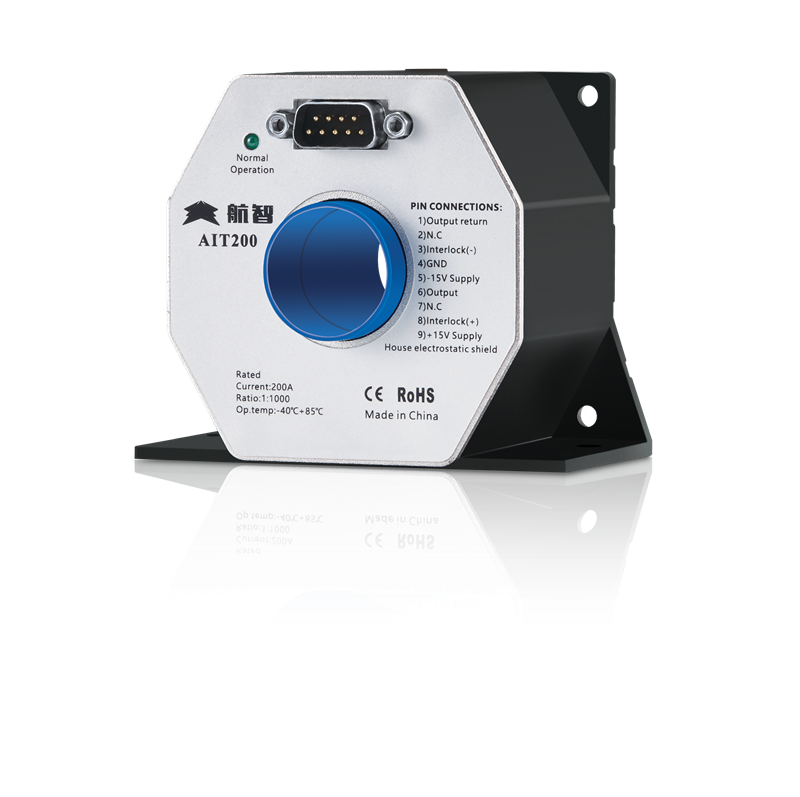 | Precision current transducers AIT 10ppm Ultra-Precision Fluxgate Current Transducer Product Overview: Achieve absolute calibration accuracy with the Hangzhi AIT Series Ultra-Precision Current Transducer. View product → |
Inspect and install the transducer before Mumbai weather reaches it
Reject any precision current transducer for humid conditions in Mumbai that shows internal condensation until the manufacturer completes its inspection and electrical checks.
1. Inspect the enclosure for moisture marks, damaged seals, cracks and contamination. Check connectors for discoloration or corrosion, terminals for green or white deposits, cable jackets for brittleness, glands for looseness, and the calibration label for an overdue date.
2. Quarantine equipment with internal condensation. Release it only after the manufacturer confirms acceptable insulation resistance, dielectric withstand and functional performance.
3. Mount the transducer above splash level, away from roof leaks, washdown paths and cabinet drains. Route cables so they never pass through standing water.
4. Form a cable-drip loop before every cable entry. Fit the specified sealed glands, tighten them correctly and preserve connector backshell protection; a damaged backshell can defeat an otherwise sealed enclosure.
5. Control dew-point risk with a cabinet heater, controlled ventilation or dehumidification where the manufacturer permits that method. Keep ventilation paths open, and provide drainage rather than trapping moisture inside the cabinet.
6. Bond the enclosure as specified. Before energising the protection or test system, verify insulation coordination, dielectric withstand and installation category against the system’s requirements, not only the transducer’s accuracy rating.
Set a humidity-driven maintenance and calibration decision process
Set inspection and calibration frequency from the manufacturer’s environmental specification and your site risk assessment, not from a universal calendar interval. Current transducer maintenance humidity in Mumbai requires a defined post-monsoon inspection because condensation and salt contamination can damage accuracy before the output fails.
1. At each risk-based inspection, look for condensation trails, salt deposits, green or white corrosion products, cable-gland damage and connector discoloration. Record cabinet humidity controls and any evidence of water entry.
2. Clean only under the manufacturer’s procedure. Do not spray water, contact cleaner or solvent into connectors; liquid can create leakage, corrosion and an intermittent signal.
3. At the specified temperature and current, record zero output, comparison with a traceable reference, noise, insulation resistance and functional response. Compare the results with the manufacturer’s tolerances and previous records.
4. After cabinet flooding, heater failure, visible moisture exposure or unexplained zero drift, open an out-of-tolerance investigation. Complete insulation checks and functional checks before returning the transducer to protection or testing service; a normal output does not prove sound insulation.
5. Increase inspection or calibration frequency when the risk assessment shows frequent condensation, salt exposure, outdoor installation or weak cabinet controls. Reduce it only when exposure history and stable records support the change.
No AIT fluxgate transducer for coastal conditions, or competing transducer, can be named best without product-level evidence. Choose the unit whose construction, test records, installation controls and post-exposure accuracy match your site risk.
Frequently asked questions
What determines precision current transducer humidity performance in Mumbai?
The complete environmental design determines performance: condensation control, enclosure sealing, salt-deposit resistance, corrosion protection, insulation spacing, connectors, and calibration stability.
Which environmental records indicate an AIT fluxgate transducer suits coastal conditions?
Ask for documented humidity, condensation, corrosion, insulation-resistance, temperature-cycling, and ingress test results covering the installed configuration.
How should you compare an AIT fluxgate transducer with other architectures?
Compare isolation, accuracy, drift, bandwidth, temperature performance, noise, saturation behaviour, maintenance requirements, and verified humidity resistance rather than sensing principle alone.
How do you manage current transducer maintenance humidity in Mumbai?
Inspect seals, terminals, connectors, mounting surfaces, corrosion, salt deposits, and insulation leakage on a scheduled basis, then trigger calibration after exposure or measurement drift.