
Executive Technical & Testing Summary: During pre-commissioning testing of transmission lines in Indian substations, automated testing of numerical distance relays frequently stalls because manufacturer-specific software templates are unavailable, unlicensed, or restricted to proprietary software packages. By applying direct mathematical parameter modeling and open XRIO characteristic reconstruction, testing agencies can regenerate complex 5-zone quadrilateral characteristics—complete with asymmetric resistive reaches, boundary tilts, and reverse backup zones—for automated testing across modern 3-phase and 6-phase secondary injection test sets without recurring software fees.
In electrical substations and industrial switchyards, commissioning engineers and testing contractors frequently encounter an operational roadblock during secondary injection testing. A numerical transmission line protection relay is erected in the Control and Relay (C&R) panel, the setting file or parameter sheet is issued by the protection cell, and automated secondary injection testing comes to an unexpected halt.
The testing team finds that the specific relay model's pre-configured software template is missing from the test library, requires an expensive software upgrade, or is restricted exclusively to one specific make of test set. When support forums like Eng-Tips or manufacturer helpdesks are consulted, the inquiry is often directed back to site: "Can the testing team build the XRIO exchange file or manually plot the impedance boundaries?"
This software dependency creates an unnecessary commercial hurdle. Testing agencies invest substantially in modern 3-phase or 6-phase secondary injection test kits, only to find the hardware constrained by expensive, vendor-locked "ready-to-test" software modules.
The Practical Challenge: Proprietary Software Dependency vs. Open XRIO Reconstruction
In the Indian electrical testing equipment market, buyers evaluating test equipment encounter two distinct testing approaches:
- High Recurring Software Charges: Many global manufacturers structure relay test software modules as a recurring expense. While the secondary injection test kit hardware is fully capable of injecting 3-phase currents and voltages with high precision, automated testing is artificially restricted behind licensed software packages.
- The Manual Testing Disadvantage: When testing agencies cannot justify recurring template software fees, they often fall back to manual point-on-wave testing—manually calculating reach impedances, shooting individual points, and drawing static boundaries on the screen. During a tight substation shutdown window, this manual method consumes critical outage hours and increases the chance of human error prior to line charging.
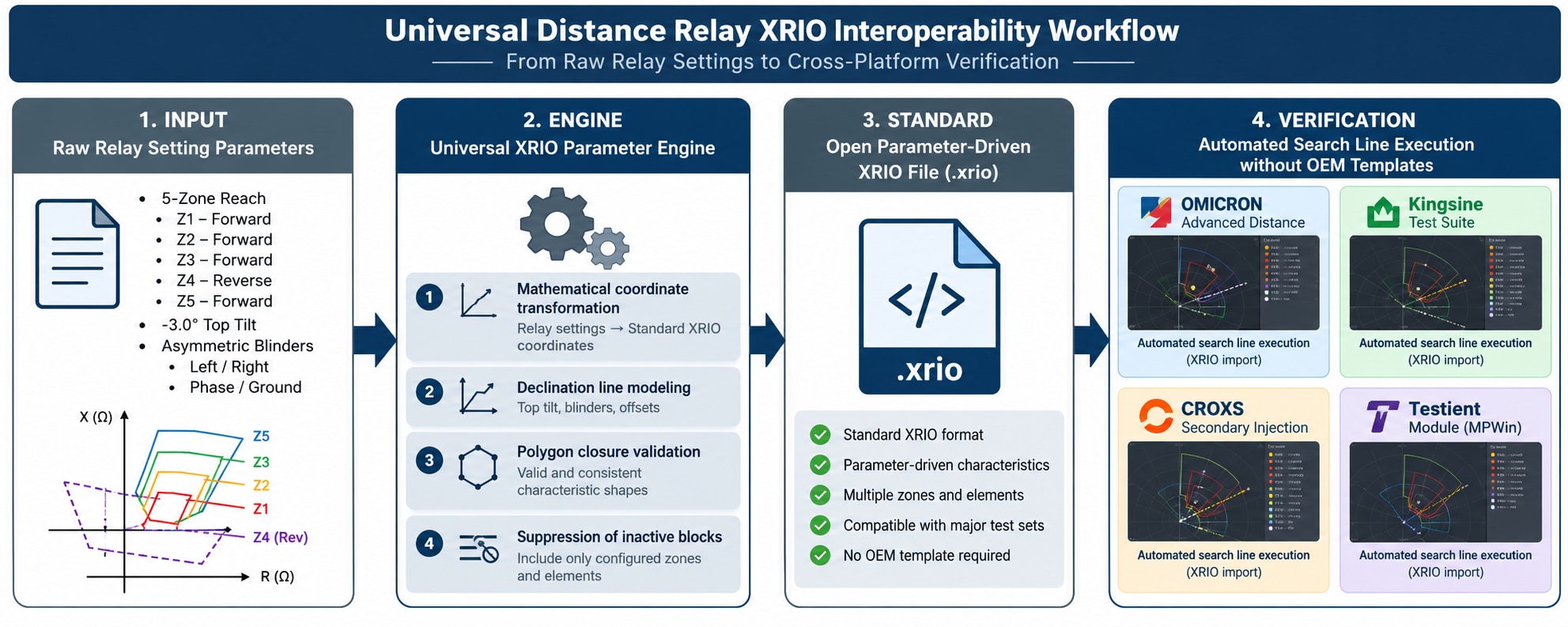
- The Engineering Approach: Automated secondary injection testing should be driven by the relay's actual setting parameters, not the test kit's software brand. A quadrilateral trip boundary is defined by line impedance parameters, fault loop mathematics, and vector geometry. When distance relay characteristic building is carried out using standardized XRIO parameter structures, any capable secondary injection test set can execute automated boundary testing.
Figure 1: Universal distance relay XRIO interoperability workflow from raw settings to multi-platform test verification.
Technical Challenges in 5-Zone Distance Relay Characteristic Building
Reconstructing and generating an advanced quadrilateral characteristic directly into an XRIO data model requires resolving intricate geometric relationships:
| Protection Parameter | Characteristic Geometry | Mathematical XRIO Building Challenge |
|---|---|---|
| Zone Architecture | 5-Zone Quadrilateral Scheme | Coordinating 4 forward reach zones with 1 reverse backup zone (Zone 4) in the XRIO structure. |
| Resistive Reach | Asymmetric Blinders (R1, R2) | Defining distinct left and right resistive boundaries without polygon distortion across test software suites. |
| Upper Reactance Line | Non-Standard Boundary Tilt (-3.0 deg) | Ensuring negative declination angles calculate smoothly without triggering auto-close errors in third-party parsers. |
| Directional Supervision | Reverse Quadrant Vectoring | Managing origin shifts and vector winding rules for Zone 4 reverse supervision. |
| Operational Baseline | Multi-Group Relays with Inactive Blocks | Defining Setting Group 1 as active while pruning unassigned Mho elements to ensure a lean, reliable data model. |
Figure 2: Cross-Platform 5-Zone R–X Characteristic Verification Across 4 Test Software Suites
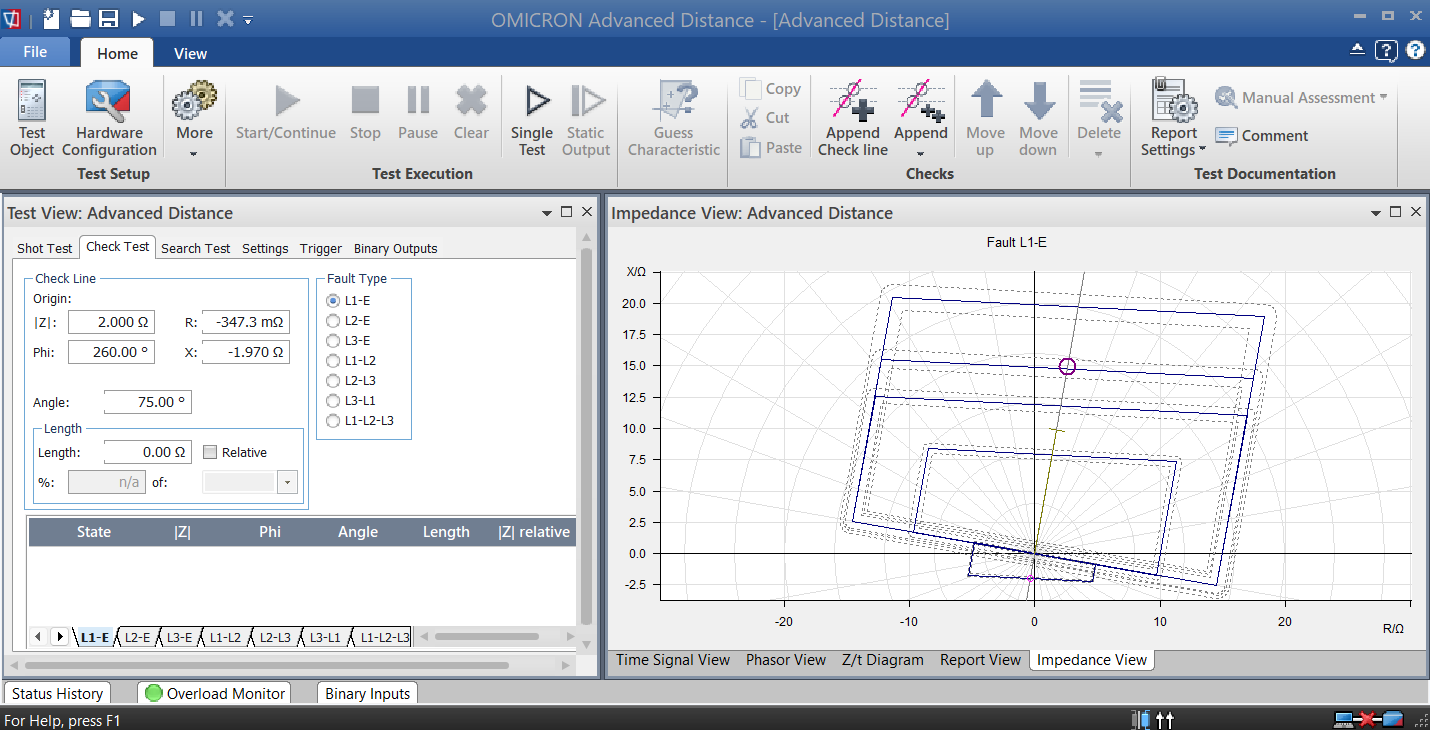 Platform A: OMICRON Advanced Distance |
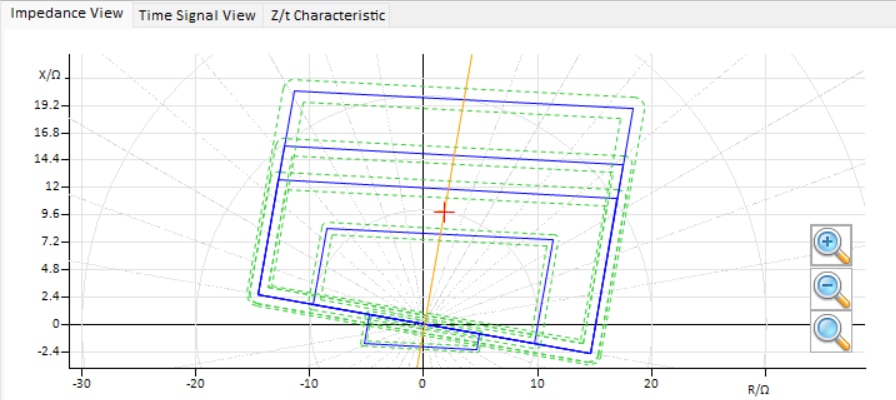 Platform B: Kingsine Test Suite |
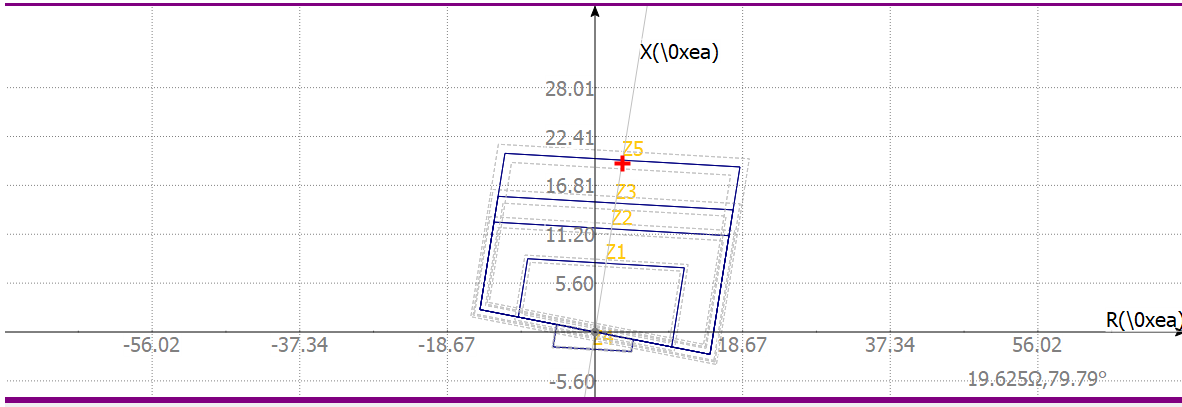 Platform C: CROXS Test Environment |
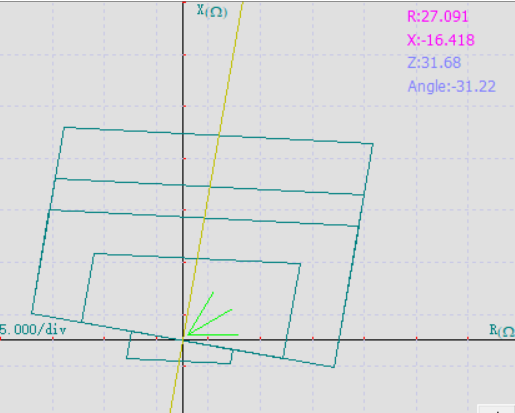 Platform D: Testient Module |
XRIO Characteristic Generation vs. Graphical Characteristic Editors
There is a fundamental technical difference between authentic distance relay characteristic generation from an XRIO file and merely exporting a shape from a graphical characteristic editor:
- Graphical Editor Output: Drawing lines in a visual editing tool produces static Cartesian coordinates. It lacks underlying parameter intelligence, fails when CT/PT ratios or reach settings change, and frequently fails to import into competing test software due to non-standard graphic metadata tags.
- Parametric XRIO Characteristic Building: Structuring the XRIO file directly from native setting formulas and vector geometry ensures that the testing software's calculation engine dynamically computes trip limits, search lines, and tolerance bands.
When constructed with mathematical rigor, the regenerated characteristic imports cleanly into diverse test environments—including OMICRON Test Universe, Tesient, CROXS, Kingsine platforms. If you are using any of the following-Doble Protection Suite, Megger SMRT, Ponovo Power, ISA Altanova platforms you can try it in your respective platform—without requiring proprietary template conversions.
100 Iterations to Validate Cross-Platform XRIO Parity
Translating native relay configuration files into an open-standard XRIO format requires resolving auto-close failures, coordinate inversions on reverse backup zones, and software-specific parsing differences.
Through nearly 100 rigorous iterative trials, the impedance boundaries were systematically refined and benchmarked across four independent secondary injection test platforms.
Verified Testing Outcomes:
- Boundary & Reach Parity: Forward reaches, reverse backup reaches, and asymmetric resistive blinders match published relay setting sheets.
- Angular & Vector Accuracy: Negative boundary tilt angles and directional supervisor slopes plot cleanly without geometric distortion.
- Hardware Independence: The single XRIO data model loads seamlessly across multiple test suites, enabling automated pickup, timing, and boundary verification on both premium and cost-effective secondary injection test sets.
Practical Value for Equipment Buyers and Commissioning Teams
For protection engineers, testing service providers, and power utilities in India, mastering distance relay characteristic generation changes the procurement and operational equation:
- Greater Choice in Secondary Injection Test Sets: You are not forced to purchase specific high-cost test kit brands solely because of software template availability. Modern, cost-effective 3-phase and 6-phase secondary injection kits can handle complex distance testing when paired with open-standard XRIO data models.
- Freedom from Proprietary Software Lock-in: By adopting parameter-based XRIO characteristic building, testing agencies avoid recurring software license fees and expensive vendor-specific template libraries.
-
Faster Commissioning Outages: Field teams eliminate manual test plotting, executing automated boundary verification within scheduled shutdown windows.
-
Need Custom Distance Relay Templates for Multi-Zone Testing?
Stuck on-site with a multi-zone numerical distance relay without a manufacturer-supplied testing template?
We assist testing agencies, EPC contractors, and utilities in converting raw relay setting schedules into test-ready parameter templates compatible with TESIENT and CROXS test environments (natively supporting standardized impedance boundary imports).
-
How It Works: Send us your approved relay setting sheet (including CT/PT ratios, zone reaches, reach angles, and directional line parameters).
-
The Deliverable: We generate a verified, ready-to-inject test profile tailored for your secondary injection software.
To discuss your testing requirements or request a custom template conversion, contact us:
✉️ Email: mail@electricaltestkit.com
💬 WhatsApp: +91 84549 40731 (Instant Chat)(Please include your company name, relay make/model, and project location for technical review.)
-