
An application-based guide to analogue testing, high-burden relays, IEC 61850, GOOSE, automation, and specification design
Introduction
When a utility, testing organization, or protection engineer plans to purchase a relay test set, it is easy to start by looking at specifications already used by another purchaser.
Existing specifications can be useful reference material. They can show what is technically possible and can highlight questions that a new purchaser may want to consider.
But a specification written for one organization should not automatically become the specification for another.
The better approach is to first identify what protection equipment and protection applications need to be tested, then identify the measurable capabilities needed for those applications, and only then prepare the equipment specification.
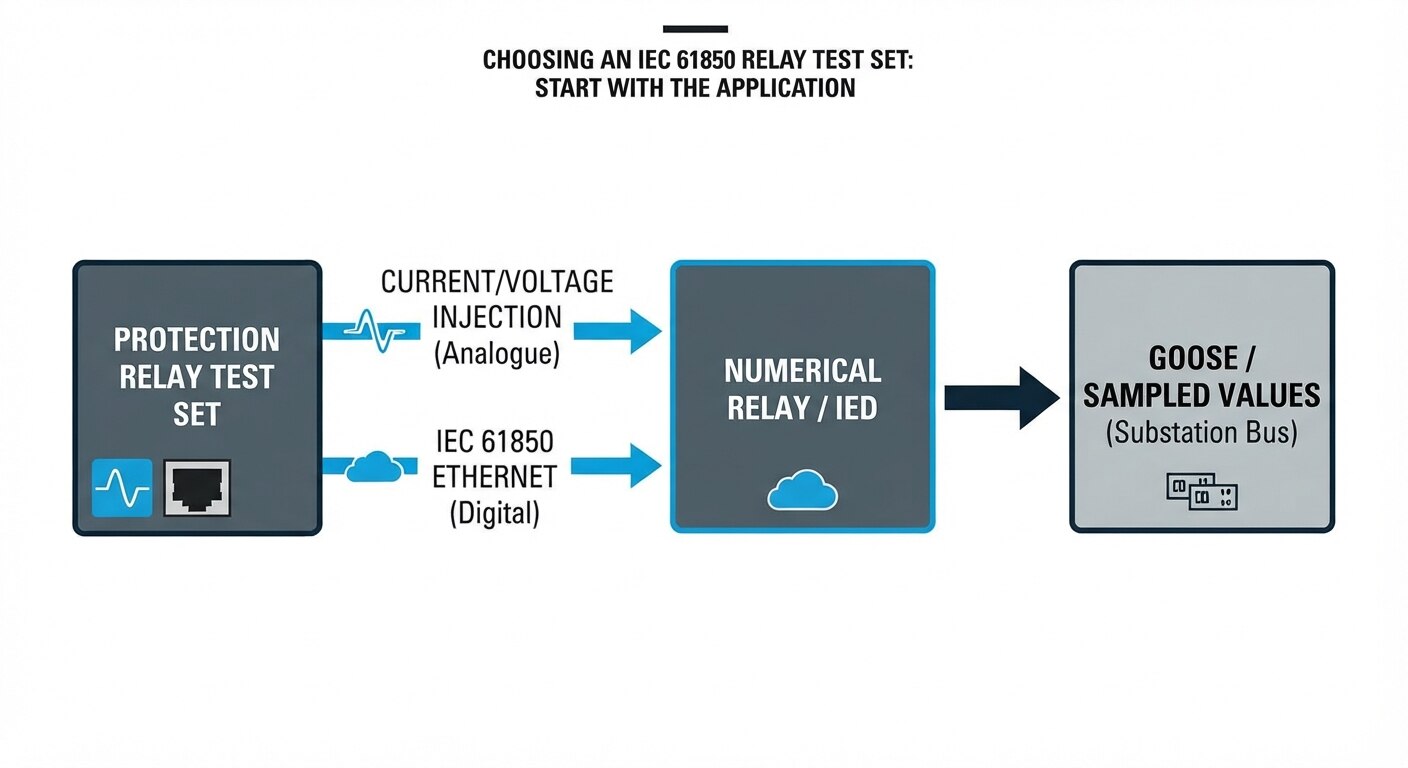
This becomes particularly important when one relay test set is expected to cover conventional electromechanical relays, numerical relays, and IEC 61850-based protection.
A continuation of the 100:1 discussion
This article follows the earlier article, “The 100:1 Problem: Why Relay Test Set VA Specifications Are Outdated for Numerical Relays," which examined the relationship between traditional relay-test-set output ratings and the requirements of modern numerical protection.
The present article takes the discussion one step further.
The question here is not which existing specification is right or wrong. It is:
How should a new purchaser develop its own relay test set specification from its own protection system and testing requirements?
Earlier article: The 100:1 Problem: Why Relay Test Set VA Specifications Are Outdated for Numerical Relays
Why another purchaser's specification should be a reference—not a template
A relay test set specification reflects the purchaser's own relay population, protection philosophy, testing practices, existing equipment, and future plans.
A new purchaser should therefore not begin with “What did another utility specify?”
A better starting question is “What do we actually need to test?”
Public specifications can show useful examples, but they should be used to understand the engineering questions behind the numbers, rather than copied line by line.
A real-world example: 30 A / 125 VA continuous
This article uses one numerical example because it appears in a publicly available purchaser's technical specification for a fully automatic relay test kit.
The purchaser specifies six current channels, each rated 0-30 A, with 125 VA continuous power per channel in the six-phase configuration.
These figures are quoted here only as a real-world example. They are not proposed as a universal industry standard or recommended minimum for every relay test set.
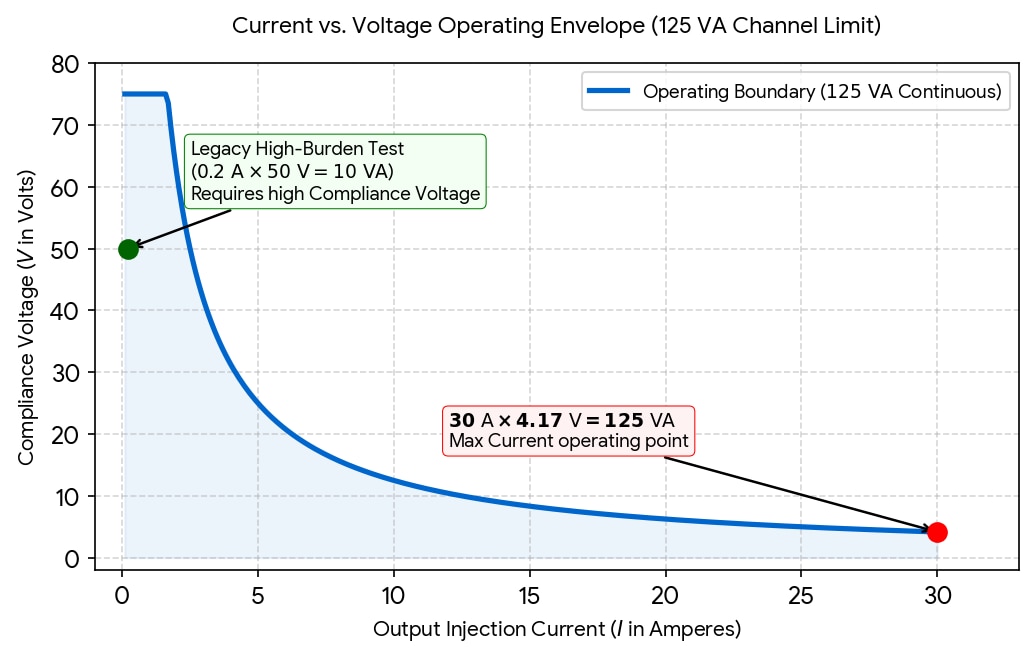
At a current of 30 A, 125 VA corresponds to approximately 4.17 V:
125 VA / 30 A = 4.17 V.
This simple calculation is useful because it shows why a headline VA figure should be understood together with the current at which the output is being considered. A single VA number does not, by itself, describe the complete current-versus-voltage operating envelope of a current source.
What does this mean for high-burden electromechanical relay testing?
Where high-burden electromechanical earth-fault relays remain in service, testing them may be an important requirement. But the words “high burden” should ideally be translated into an actual application requirement.
If a relay is tested at a low current, the relevant question may be how much voltage the current source can continuously maintain at that current and for the required duration.
Consider 0.2 A only as an illustrative low-current test point:
0.2 A x 25 V = 5 VA
0.2 A x 50 V = 10 VA
0.2 A x 75 V = 15 VA
0.2 A x 100 V = 20 VA
These examples do not establish what any particular relay requires. The correct value depends on the actual relay burden, test current, waveform, and duration.
The key lesson is that a headline statement such as '30 A / 125 VA continuous' should not automatically be treated as a complete definition of high-burden performance.
If high-burden electromechanical relays are not the main requirement
This is equally important.
Where the principal work is testing modern numerical and IEC 61850-based protection, it may not be sensible to make a very large analogue current or VA rating the dominant selection criterion.
Suitable analogue current and voltage capability is still needed for the intended relay tests. But the purchaser should give appropriate importance to the digital and software functions that are actually used in the protection system.
The objective is not to remove high-burden capability. It is to give each capability the importance justified by the purchaser's actual and expected testing workload.
IEC 61850 should be specified by application:
The phrase “IEC 61850 compatible” is useful, but it does not by itself explain what the purchaser needs to test.
The purchaser should first identify how IEC 61850 is used in its protection system. Depending on the application, relevant functions may include station-bus communication, GOOSE, MMS-related functions, or sampled values.
Not every installation needs all of these functions.
Where GOOSE is used in protection logic, the purchaser should define the GOOSE functions actually required. Where sampled values are part of the protection application, the purchaser should define the required SV use case.
This avoids turning a general protocol label into a long feature checklist that may not correspond to the purchaser's real work.
GOOSE: specify the protection application, not only the protocol name.
GOOSE may be used for fast protection and automation signals such as trip, blocking, interlocking, or other logic.
The useful purchasing question is, therefore, not simply “Does the test set support GOOSE?”
The more useful question is, 'What GOOSE-based protection functions are present, and what does the purchaser actually need to test?'
The specification can then be written around the real protection application rather than around a generic feature claim.
Analog channels, voltage, and current output
IEC 61850 does not eliminate analogue relay testing. Numerical protection IEDs may still be tested with current and voltage injection together with binary status and trip signals.
The purchaser should therefore determine the number of simultaneous current and voltage sources needed for its own applications, together with current and voltage ranges, accuracy, phase-angle control, frequency performance, and continuous output capability.
Channel count should follow the testing application rather than become a competition in numbers.
Binary inputs and outputs
Protection testing still involves trip contacts, breaker status, start signals, alarms, and interlocking.
The purchaser should determine the required number and electrical characteristics of binary inputs and outputs from its own testing work.
Where fast protection logic is important, response time may also be relevant.
A higher number of inputs or outputs is not automatically better if they are not needed.
Automation and software
A relay test set is not only a source of current and voltage. Testing teams may repeatedly perform pickup, timing, characteristic, distance, differential, directional, and logic tests.
Software automation can reduce repetitive manual work and improve consistency.
A purchaser should identify which tests need automation and what information needs to be stored or reported. The requirement should describe the work that needs to be done rather than simply asking for “advanced software."
Disturbance and COMTRADE replay, where disturbance-record analysis or replay is part of the intended work; compatibility with the relevant recorded waveform data can be useful. But this should again be application-driven. A purchaser that regularly uses disturbance records may need this capability as part of its normal workflow. A purchaser that does not use disturbance replay may not need to make it a major selection criterion. A feature should be included because the purchaser has a defined use for it, not simply because it appears in another purchaser's specification.Communication and connectivity
IEC 61850 testing requires suitable communication connectivity between the test system and the equipment under test.
The required interface type and number should therefore follow the actual test arrangement and protection architecture.
The correct requirement is the one needed for the application, not simply the largest number of ports.
Automation and software
A relay test set is not only a source of current and voltage. Testing teams may repeatedly perform pickup, timing, characteristic, distance, differential, directional, and logic tests.
Software automation can reduce repetitive manual work and improve consistency.
A purchaser should identify which tests need automation and what information needs to be stored or reported. The requirement should describe the work that needs to be done rather than simply asking for “advanced software."
Disturbance and COMTRADE replay
Where disturbance-record analysis or replay is part of the intended work, compatibility with the relevant recorded waveform data can be useful.
But this should again be application-driven. A purchaser that regularly uses disturbance records may need this capability as part of its normal workflow. A purchaser that does not use disturbance replay may not need to make it a major selection criterion.
A feature should be included because the purchaser has a defined use for it, not simply because it appears in another purchaser's specification.
Communication and connectivity
IEC 61850 testing requires suitable communication connectivity between the test system and the equipment under test.
The required interface type and number should therefore follow the actual test arrangement and protection architecture.
The correct requirement is the one needed for the application, not simply the largest number of ports.
How a new purchaser should build its own specification
A practical process is the following:
- 1. List the relay and IED types that will actually be tested.
- 2. List the protection functions that will actually be tested.
- 3. Decide how important legacy high-burden relay testing is.
- 4. Identify the IEC 61850 functions actually used by the protection system.
- 5. Determine the required current and voltage channels and output capability.
- 6. Define accuracy, phase, frequency, and binary I/O requirements.
- 7. Identify the software and automation functions that will genuinely be used.
- 8. Add special functions only where there is a defined application.
Only then should the purchaser decide the final technical ratings and feature requirements.
Avoid both under-specification and over-specification.
There are two opposite risks.
Under-specification can make it difficult to establish whether a test set is suitable for the intended application.
Over-specification can unnecessarily exclude technically suitable equipment and can make the procurement depend on specifications that have little practical value to the purchaser.
A balanced specification should distinguish between core requirements and application-dependent requirements.
A feature should not become mandatory merely because it appears in another purchaser's specification or another product's catalogue.
The larger lesson
Modern relay test sets may have to serve several generations of protection technology at the same time.
That does not mean that every purchaser needs the same combination of analogue power, channels, communications, and software.
The most useful specification is therefore not necessarily the one with the largest current rating, the highest VA rating, or the longest feature list.
It is the specification that accurately represents the purchaser's protection-testing applications.
Conclusion
The central principle is simple:
Do not copy another purchaser's relay test set specification.
Use published specifications to understand the questions. Then answer those questions for your own relay population and protection system.
If high-burden electromechanical relays are important, define the actual burden and corresponding current/compliance requirement.
If numerical and IEC 61850 protection is the main workload, define the actual digital functions required and give appropriate weight to the analog, software, and automation capabilities needed for those applications.
The example of 30 A / 125 VA continuous power illustrates why a headline number should be understood in context. Those figures come from one publicly available purchaser specification; they are not a universal recommendation.
A well-designed specification should therefore follow a simple sequence:
Understand the application -> define the measurable requirement -> select the appropriate capability.
Not:
Copy an existing specification -> copy its features -> choose a product.
Technical source note
The numerical example and procurement observations in this article are based on the publicly available technical specification:
Gujarat Energy Transmission Corporation Ltd. (GETCO)
Technical Specification for Fully Automatic Relay Test Kit
Document reference: GETCO/E/TS – TEST EQUIP 04/R3 AUG-25
Technical file: “F6 Revised Tech Spec Relay Test Kit 61850 8-1.pdf”
The specification identifies six 0-30 A current outputs and 125 VA continuous power per channel in six-phase operation. It also requires coverage of electromechanical, static, and numerical relays, including IEC 61850-8-1-compatible relays with GOOSE testing, and states that the equipment must be capable of testing high-burden electromechanical earth-fault relays.
The figures and requirements from that document are used as examples of one purchaser's stated requirements. They are not presented as universal standards or recommended specifications for other purchasers.
This article does not identify, endorse, or compare any manufacturer or model.
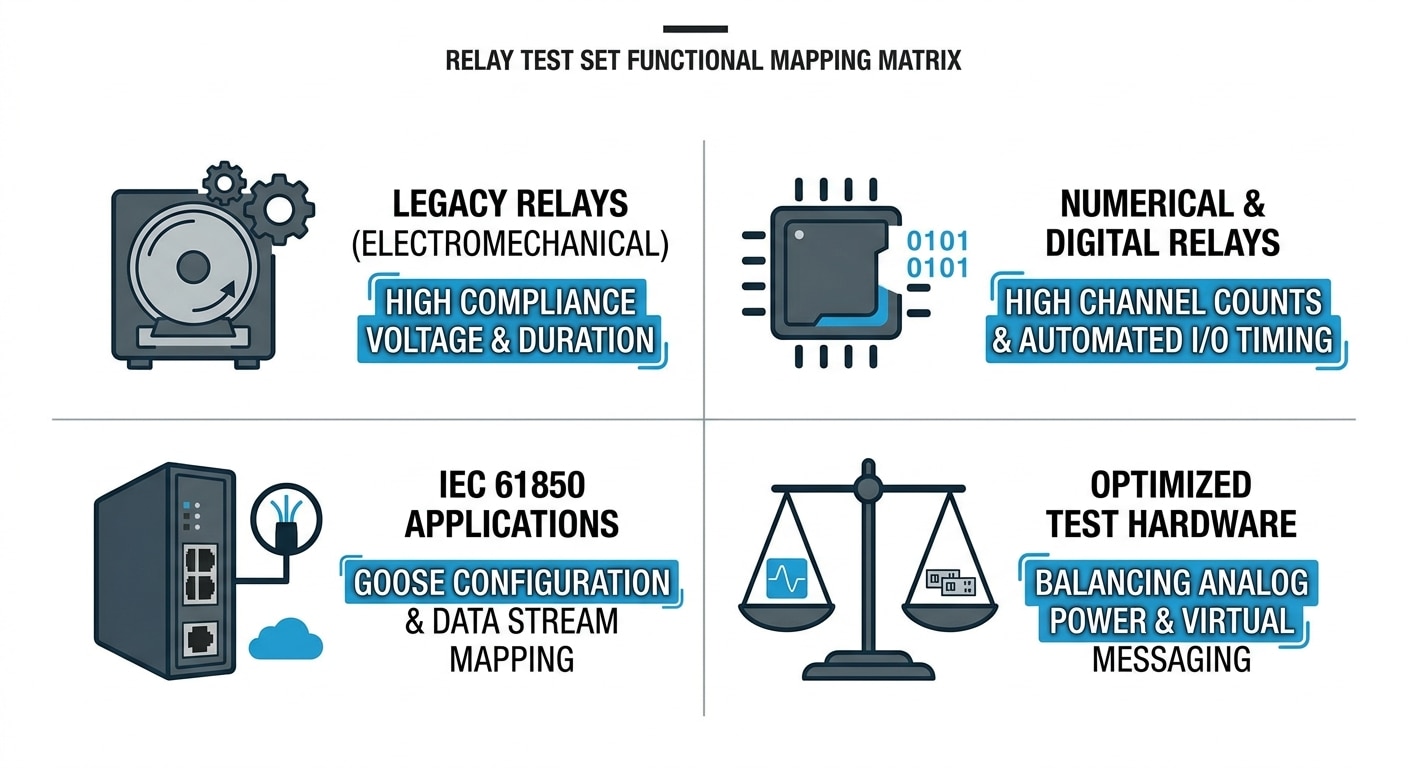
Quick purchaser framework
|
Primary application |
Give greater attention to |
Do not make the sole discriminator. |
|
Legacy/high-burden relays |
Actual burden, current, compliance voltage, and duration |
Headline: current or VA alone |
|
Numerical relay testing |
Analogue channels, accuracy, automation, software, and binary I/O |
Maximum output rating alone |
|
IEC 61850 / GOOSE |
The IEC 61850 functions are actually used by the protection scheme |
“IEC 61850 compatible” alone |
|
Mixed conventional + digital |
Balanced analogue and digital capability |
Either side in isolation |