


High Precision EV Battery Current Sensors & Transducers
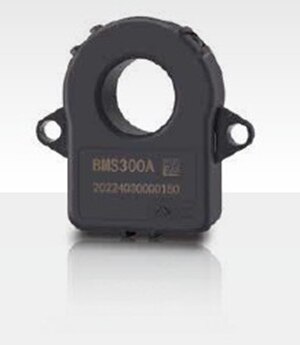
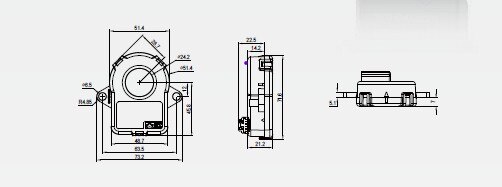
Figure 1: The Hangzhi BMS Series through-hole chassis layout, featuring a contactless 24.2mm window for safe high-voltage primary isolation up to 1500A.
If your engineering team is currently battling persistent State of Charge (SOC) tracking errors caused by thermal shunt degradation or open-loop Hall drift, your sensor architecture has reached its physical limits. Learn how laboratory-grade, zero-magnetic-flux closed-loop technology provides true plug-and-play precision for premium EV battery disconnect units.
Why Standard Current Sensors Fail in EV Battery Packs: Shunts vs. Hall Effect vs. Fluxgate
To avoid cutting the high-voltage cable, many engineers switch to contactless magnetic current sensors, most commonly Hall Effect sensors. These devices measure the magnetic field generated by the current passing through a conductor using a slotted magnetic core.
- Zero-Point Magnetic Drift: When an EV sits in traffic or idles at low current draw, Hall Effect sensor chips experience significant zero-point output drift. This causes the BMS to continuously miscalculate background energy usage, introducing cumulative errors into the battery metrics.
- Magnetic Core Saturation: If the vehicle experiences a sudden current spike—such as a regenerative braking burst or a minor short-circuit surge—the internal magnetic core of a Hall sensor can saturate. Once saturated, the sensor loses linearity and cannot provide reliable overcurrent protection data back to the vehicle's master control system.
- EMI Vulnerability: Traditional Hall chips rely on opening up or cutting into the magnetic loop core, making them highly vulnerable to external electromagnetic interference (EMI) generated by neighbouring high-frequency motor inverters
- Zero-Point Magnetic Drift: When an EV sits in traffic or idles at low current draw, Hall Effect sensor chips experience significant zero-point output drift. This causes the BMS to continuously miscalculate background energy usage, introducing cumulative errors into the battery metrics.
- Magnetic Core Saturation: If the vehicle experiences a sudden current spike—such as a regenerative braking burst or a minor short-circuit surge—the internal magnetic core of a Hall sensor can saturate. Once saturated, the sensor loses linearity and cannot provide reliable overcurrent protection data back to the vehicle's master control system.
- EMI Vulnerability: Traditional Hall chips rely on opening up or cutting into the magnetic loop core, making them highly vulnerable to external electromagnetic interference (EMI) generated by neighbouring high-frequency motor inverters.
| Technical Parameter
| Standard Shunt Resistor
| Open-Loop Hall Effect
| Closed-Loop Fluxgate (Hangzhi BMS)
|
| Global System Accuracy
| Variable (drifts under load)
| ±1% To ±2% | ±0.5% across the full temp spectrum |
| Temperature Drift | High (requires heavy software mapping) | Severe (zero-point shifts over time)
| Ultra-Low / Completely Self-Correcting
|
| Installation Layout
| Direct Terminal Cut (creates heat risk)
| Slotted Magnetic Core (EMI Sensitive)
| Isolated Pass-Through / Through-Hole
|
| Output Type
| Raw Millivolt Analogue Signal
| Low-Level Analogue Voltage
| Direct CAN Bus Digital Signature
|
| Development Lifecycle
| Complex, slow calibration times
| Moderate circuit shielding needed
| Instant Plug-and-Play System Sourcing |
If your engineering team is currently troubleshooting any of the following issues during field trials, your sensor architecture has likely hit its physical limits:
- Symptom A: The battery's calculated State of Charge (SOC) changes or "drifts" overnight when the vehicle is parked completely idle. (Diagnosis: Open-Loop Hall Zero-Point Drift)
- Symptom B: Range estimation values become highly inaccurate immediately following a 15-minute DC fast-charging session. (Diagnosis: Shunt Resistor Thermal TCR Shift)
- Symptom C: The BMS fails to trigger safety contactors fast enough during a high-load inductive spike. (Diagnosis: Core Saturation Blindness)
When looking at upfront component pricing, a basic Hall sensor or shunt can seem like an attractive option. However, the traditional route quickly becomes expensive when you take into account the engineering hours required to correct SOC errors, the cost of adding external filtering circuits, and the financial risk of field recalls due to battery miscalculations.
Switching to a laboratory-grade, zero-drift fluxgate current sensor helps private Indian EV pack assemblers and tier-1 design OEMs shorten development cycles, reduce vehicle system weight, and provide highly reliable range metrics to end consumers.
