

The purchase is worthwhile when your commissioning work demands repeatable multi-phase fault simulation, coordinated logic checks and audit-ready reports across many relays. By comparing the required channels, test methods, workflow, automation limits and ownership costs, you can decide whether to buy, rent, hire a specialist or use equipment already available.
Key takeaways
- Buy automation when repeated tests outweigh setup and reporting time.
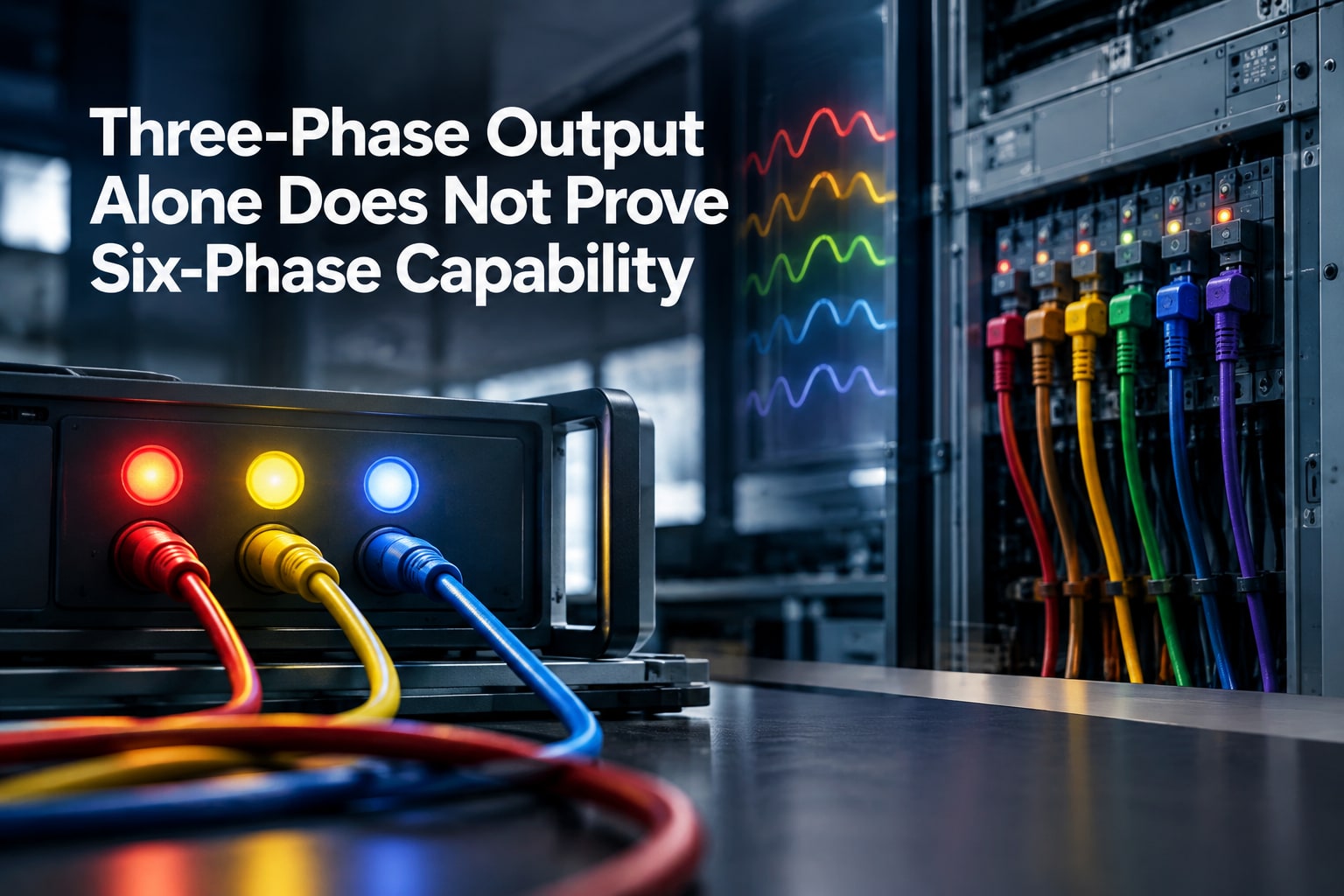
- Confirm three-phase output meets your relay schemes; it does not mean six-phase capability.
- Use secondary injection to prove relay operation, not the complete protection circuit.
- Compare software, training, calibration, service response and report generation before buying.
When the commissioning workload justifies the premium
The premium pays back when your team repeats standardised tests across many feeders, substations or relay models. A three-phase automatic relay tester for commissioning teams reduces connection changes, reruns pickup and trip-time tests consistently, and produces machine-generated reports instead of requiring engineers to assemble evidence manually.
| Option | Cost advantage | When it applies |
|---|---|---|
| Existing manual or single-phase set | Lowest new spend | A few simple overcurrent relays where rewiring takes less time than purchasing and configuring automation |
| Rental | Avoids ownership, calibration and storage | A one-off project, provided the required channels, software and delivery date are guaranteed |
| Specialist testing service | Transfers setup and interpretation risk | Complex protection, limited internal expertise or a project with too little repeat work to build templates |
| Automatic three-phase tester | Reduces repeated labour and documentation time | Multiple directional, distance, differential, generator or line-protection schemes with reusable test plans |
| Existing six-phase set | Avoids a new purchase and reconnection | Transformer differential work or schemes that need simultaneous independent current injection on both sides |
Do not count a nominal three-current/three-voltage unit as a complete differential solution. Vector-group shift, ratio compensation, tap position and zero-sequence treatment can force reconnection or a second set, erasing the saving. A relay test set for commissioning contractors also cannot replace coordinated end-to-end line testing, channel simulation or IEC 61850 protocol testing.
Buy only when your team will use templates, preserve raw results and issue repeatable reports; unused automation is expensive equipment, not productivity.
Three-phase output is not the same as six-phase capability
Three current and three voltage channels are enough only when the relay scheme can be tested from one three-phase source. That covers many overcurrent, directional, distance, voltage, frequency and negative-sequence tests, provided each channel is independently controlled and remains within its rated output when all channels operate together.
Ask how many independent quantities your actual test plan needs:
- Three current channels: suitable for one three-phase relay input, including phase-to-phase, phase-to-earth and three-phase faults.
- Six current channels: important for transformer differential testing, where you inject currents on both transformer sides while applying ratio, vector-group, tap and zero-sequence compensation. Without six currents, you may need reconnections, a second test set or a specialised configuration.
- Three voltage channels: sufficient for one three-phase voltage system and many distance, directional and voltage-element tests.
- Six voltage channels: necessary only when the scheme or simulator requires two independently controlled three-phase voltage systems. Do not assume a tester has them because its brochure says “three phase.”
Check maximum current per channel, parallel-current output, compliance voltage, phase-angle accuracy, frequency range and simultaneous-output ratings. A three phase relay testing equipment India purchase that hides these figures can fail precisely when a differential or high-burden test is loaded.
The same discipline applies when comparing an automatic relay tester for substations: count independent channels, not the label. A six-phase unit is valuable only if your commissioning sequence uses the extra current or voltage sources.
What a repeatable commissioning sequence must cover
Automation is only repeatable after the test model matches the approved relay settings and drawings. Confirm firmware, setting-group name, CT and VT ratios, nominal frequency, characteristic curves, pickup values, time delays, binary logic and pass/fail tolerances before connecting equipment.
- Isolate the relay from live CT and VT circuits, block unwanted breaker operation, and confirm the isolation with the commissioning permit. Prove CT secondary continuity and earthing; never open an energised CT circuit.
- Connect the tester’s three current and voltage outputs to the correct relay terminals, observing polarity, phase sequence and neutral connections. Wire isolated binary inputs to trip, pickup, breaker auxiliary, lockout and reclosing contacts, then verify wet or dry contact settings.
- Load the approved test plan and check its channel mapping against the terminal drawings. Validate phase rotation, scaling and fault quantities before running automatic protection relay testing; a wrong ratio can produce a perfectly repeatable wrong result.
- Run stable-state checks, pickup and dropout tests, time-current points, directional elements and the scheme-specific functions. Add differential bias, distance zones, negative sequence, frequency, breaker-failure or autoreclose tests when those functions are enabled, and record measured operating time against tolerance.
- Review every failed point before repeating it; do not overwrite the original result. Save raw waveforms, software and test-plan versions, operator, date, relay identity and signed report.
- Remove injections, restore CT and VT links, trip circuits, interlocks and setting group, then perform a point-to-point check and obtain an independent restoration sign-off. The relay is not commissioned until its normal indications and control-room signals are confirmed.
What secondary injection proves—and what it leaves untested
Secondary injection verifies a relay’s measured response and internal logic under defined currents, voltages, frequency, phase angles and binary conditions. It can prove pickup, timing, directional elements, differential restraint, distance zones, trip commands, alarms and autoreclose sequences at the relay terminals. It cannot prove plant-side behaviour.
| Test type | What it proves | When to add it |
|---|---|---|
| Secondary injection | Relay characteristics, settings, logic and local inputs and outputs | Use for routine automatic protection relay testing |
| Primary injection | CT polarity, ratio, excitation, saturation and the complete CT-to-relay current path | Add when CT circuits are new, modified or critical to differential protection |
| Wiring and functional test | Continuity, terminal allocation, interlocks, DC-trip circuits and trip-circuit supervision | Add after wiring work or whenever drawings and as-built connections differ |
| Breaker test | Breaker opening and closing time, trip-coil operation, auxiliary contacts and mechanism performance | Add before declaring the protection-and-breaker function commissioned |
| End-to-end test | Coordinated line-protection operation across both terminals and the communications channel | Add for teleprotection, permissive, blocking or current-differential schemes |
An automatic relay tester for substations cannot establish end-to-end operation from one terminal. That test needs coordinated injection at both ends, a channel or channel simulator, accurate time synchronisation and a defined fault scenario.
Validate the test model against approved settings and drawings first; automation can repeat an incorrectly scaled or incorrectly wired test with perfect consistency.
A purchase checklist for capability, support and total cost
A search for three phase relay testing equipment india is not a specification: price the complete commissioning kit. Ask whether the set has independently controlled current and voltage channels, binary I/O, safe test leads, a transport case, and mains input suited to your sites.
For a relay test set for commissioning contractors, include licences, training, freight, annual calibration and downtime.
- Request a current calibration certificate from an accredited laboratory, with measurement uncertainty stated for voltage, current, phase angle, frequency and timing. Ask Myriad Industrial Solutions LLP for this evidence rather than accepting an accuracy percentage alone.
- Demonstrate distance testing with impedance-plane plots, fault-loop selection, prefault load, source impedance, fault inception angle, load encroachment and zone timers.
- Demonstrate transformer differential testing with vector-group shift, ratio compensation, tap position and zero-sequence treatment. Confirm that the channel count avoids repeated reconnections.
- If your sites use IEC 61850, verify sampled-value and GOOSE publishing or subscription, quality-bit handling, network supervision and PTP time synchronisation.
- Confirm local repair, spare-part and software support in India, plus response times, loan equipment and calibration turnaround.
| Option | Check before buying | Cost consequence |
|---|---|---|
| Buy | Hardware, licences and support cover your recurring schemes | Highest capital cost, lower repeat-test cost |
| Rent | The rental unit matches channels, interfaces and software | Lower capital cost, but availability and repeatability risk |
| Specialist | The contractor supplies testing, reports and responsibility | Lowest ownership burden, higher mobilisation cost |
A three-phase output that cannot test your relay families, or a set with no local calibration path, is a false saving. Compare five-year ownership cost against rental days and specialist mobilisation—not the purchase price alone.
Related products
 | PRODUCTS Three phase automatic Relay test set Six Phase Protection Test System The powerful three-phase relay test set MP3000A is designed for multipurpose field test and commissioning... View product → |
 | PRODUCTS The MP3000A Universal Relay Testing System is a state-of-the-art solution engineered for precision, reliability, and efficiency in relay testing. View product → |
Frequently asked questions
When is a three-phase automatic relay tester worth buying?
It is worth considering when your team repeats standardised tests across many feeders, substations or relay models and needs consistent results and machine-generated reports.
Does three-phase output mean a tester has six-phase capability?
No. Three-phase output provides three simultaneous current or voltage channels. Six-phase capability requires six independently controlled output channels for schemes that need them.
What does secondary injection testing prove?
It proves relay settings, pickup values, trip times, logic and selected protection functions under injected electrical conditions. It does not prove every CT, VT, wiring, trip-coil or breaker operation in the primary circuit.
What should commissioning teams check before buying a relay test set?
Check output channels, current and voltage ratings, phase-angle control, automation software, supported relay libraries, report formats, calibration, training, repair support and total ownership cost.
Related products
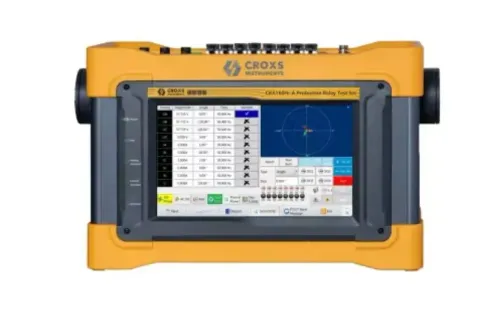
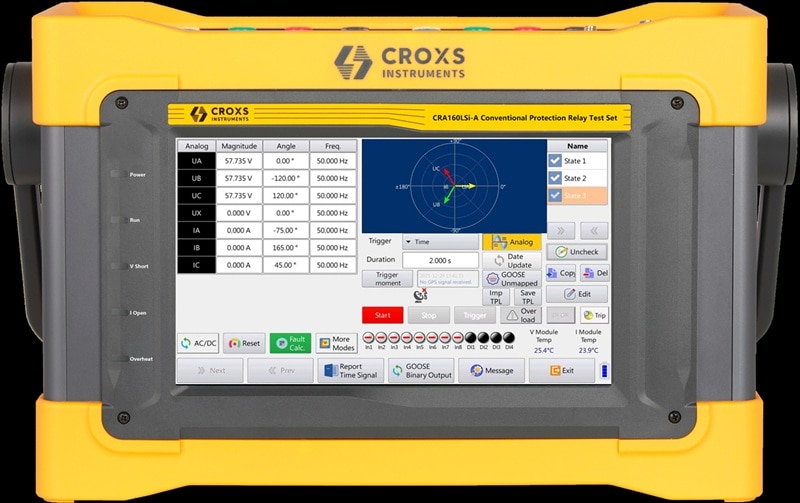 | Protection Relay Test System CRA160LSi-A Three Phase Automatic 6U6I Relay Test Set (AC-Mains Operated) The CRA160LSi-A is an automated, AC-mains-operated secondary injection test system (6U6I) designed for high-precision, analog testing of relays,... View product → |
 | Protection Relay Test System CRA160Hi-A Three Phase Automatic Relay Test Set (IEC 61850 Digital Smart Grid Tester) The CROXS CRA160Hi-A is an automatic, secondary injection relay test system designed for digital substations, generation plants, and high-voltage... View product → |
 | Protection Relay Test System CRA160LHi-A Three Phase Automatic Relay Test Set (AC-Mains, Extended 4x300V Voltage) CRA160LHi-A Three Phase Automatic Relay Test Set (AC-Mains, Extended 4x300V Voltage) The CRA160LHi-A Protection Relay Test Set is a premium,... View product → |
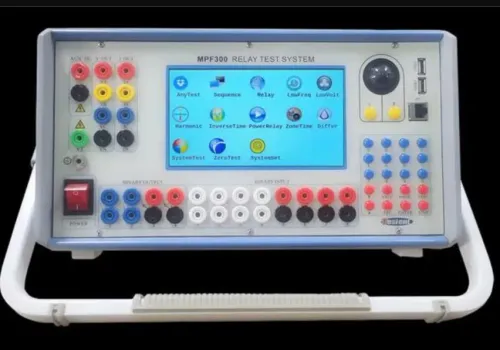
 | PRODUCTS TESIENT MPF300 PORTABLE RELAY TESTER INDIA Tesient MPF300 - 3-phase relay tester: 3×40A (100A parallel), 4×300V, touchscreen, 13 modules, 0.1%... View product → |