

A substation contractor needs more than a small instrument and a headline test current: the meter must produce defensible readings on breaker poles, disconnectors, busbar joints and cable lugs without compromising isolation or safety. By the end, you will know which specifications to compare, how to run the test, when 10 A is insufficient, and what to demand from a Mumbai supplier before placing an order.
Key takeaways
- Choose four-wire Kelvin measurement, not the smallest displayed increment.
- Place sense leads inside the current contacts on each test connection.
- Compare readings with manufacturer limits and phase-to-phase consistency.
- Confirm 10 A output, calibration records, accessories and local support before ordering.
Which specifications matter in a compact micro ohm meter?
A dependable micro ohm meter for commissioning is defined by its measurement method, not its smallest displayed increment. Four-wire Kelvin measurement uses force-current leads to inject current and separate sense-potential leads placed inside the current contacts, so lead resistance is excluded. A two-wire tester includes both lead and contact resistance.
| Connection | Result | Buying decision |
|---|---|---|
| Four-wire Kelvin | Sense leads measure voltage across the test joint inside the current contacts | Suitable for micro-ohm commissioning |
| Two-wire | Lead and contact resistance enter the result | Reject for dependable contact-resistance work |
| 1 micro-ohm display | Shows fine increments, not measurement accuracy | Demand the accuracy specification |
Require the supplier to state:
- Measurement range, accuracy as a percentage of reading plus digits, repeatability and temperature coefficient
- Selectable test current, test duration and duty cycle, including whether current is continuous or pulsed
- Display resolution and stored-reading capability with USB, Bluetooth or file export
- Automatic polarity reversal or thermal-EMF compensation to reduce offset errors
- Open-lead detection, overload indication and controlled shutdown
- Safe current interruption or controlled discharge for inductive circuits
A reading that changes with clamp pressure, dirty contact surfaces, cable movement or temperature is not rescued by extra display digits. Specify the intended test current and require evidence at that current; otherwise a low-resistance tester can look precise while producing an unreliable commissioning record.
How should you connect and test substation equipment?
1. Isolate the circuit, apply the approved lockout/tagout, and prove dead with a rated voltage detector. Discharge the equipment, apply the approved earths, and confirm the test boundary before attaching any lead.
2. Close the device under test so the intended current path is complete. On a circuit breaker, test each main-current pole separately. For a disconnector, busbar joint, cable lug or earth-switch connection, place the leads across that specific closed path, not across an adjacent parallel route.
3. Use four-wire Kelvin connections. Put the force-current clamps outside the sense-potential contacts on the same conductor path; the meter then excludes lead and clamp resistance from the measured section. Clean bright, suitable contact points first, and keep every clamp firmly seated.
4. Start the test without moving the leads. Wait for the displayed resistance to settle, then record the test current, resistance, equipment identification, pole or joint, and conductor temperature. Reverse polarity or use automatic polarity reversal when thermal electromotive force could affect the result.
5. Stop the test through the instrument’s controlled shutdown. Wait for current decay and any discharge indication before touching a lead; never remove a connection while test current flows. Conductors connected to a transformer, motor or shunt reactor can retain magnetic energy, so allow the meter to manage discharge before reapplying the approved earth.
6. If the value wanders, stop and inspect clamp stability, contaminated surfaces, cable movement, current-path changes and settling time. Do not report an unstable number as a valid field result.
What does a reading mean, and which limit should you use?
Use no universal pass value: judge each circuit-breaker pole, bolted joint, disconnector or busbar connection against acceptance criteria from the equipment manufacturer, approved project specification or utility standard. For a breaker, record each closed main-current path pole by pole; a low reading on one pole does not prove every pole passes.
Compare readings only under matching conditions:
- The same pole or joint
- The same test current
- The same force and sense-lead placement
- A stable equipment temperature
- The previous commissioning or maintenance reading
Thermal electromotive force, oxidised contact surfaces, loose clamps, cable movement, insufficient settling time and a changed current path can produce unstable results. Reversing current polarity, manually or through automatic instrument compensation, helps reduce thermal-EMF error; it does not correct a poor connection.
| Instrument | What it measures | Correct use |
|---|---|---|
| Micro-ohm meter | Very low resistance through separate Kelvin current and sense leads | Contact resistance in breakers, disconnectors and joints |
| Milliohm meter | Low resistance over a higher range or with lower resolution | Use when the equipment specification accepts its range and accuracy |
| General multimeter | Resistance through its leads and contacts, or a limited low-resistance mode | Screening only; do not apply its result as a contact-resistance acceptance test |
| Transformer winding-resistance tester | Inductive winding resistance with controlled current decay and discharge | Test transformer windings; do not apply contact-resistance limits to them |
When is a compact 10 A meter enough for the job?
10 A is enough for portable checks when the equipment manufacturer or project specification permits that current and the contact path is short, clean, and stable. Choose 50 A, 100 A, or 200 A for large breaker contact systems, long conductors, oxidised or mechanically variable contacts, or readings needing faster stabilisation and stronger repeatability.
| Option | Practical advantage | Cost or constraint |
|---|---|---|
| 10 A battery unit | Light, portable, with lower battery and cable demand | Fewer high-current tests and slower settling on difficult contacts |
| 50–100 A unit | Better repeatability across breaker contacts, joints, and longer paths | Larger leads, more heat, greater battery demand, and added weight |
| 200 A unit | Strongest excitation and rapid stabilisation on demanding paths | Thick leads, high thermal duty, heavier equipment, and fewer consecutive tests |
“High current” is not enough as a specification. State whether output is continuous or pulsed, because a 100 A meter with long or undersized leads can heat, lose voltage, or require longer cooling intervals.
A mains-powered unit may sustain more tests than a smaller battery model; physical compactness alone does not prove compact micro ohm meter availability.
In the procurement request, state:
- Test current and duty cycle
- Number of consecutive tests and recharge or mains-access limits
- Current-lead cross-section, length, and clamp type
- Site power restrictions
What should you verify with a Mumbai supplier before ordering?
Ask a compact micro ohm meter supplier for substation contractors in Mumbai to quote the exact configured unit, not merely a model number. Confirm that the stated current, Kelvin lead set and calibration certificate are available in India, with delivery location and lead time shown.
- State the test current, selectable levels, continuous or pulsed operation, test duration and duty cycle. Require lead cross-section, length, clamp type and current rating; a 200 A meter paired with undersized leads can overheat.
- Confirm battery configuration, recharge time, stored-reading export, four-wire connection, polarity reversal or thermal-EMF compensation, open-lead and overload indication, controlled shutdown, and accuracy at your intended current.
- Request enclosure and connector specifications for dust and high humidity, operating humidity, IP rating, CAT rating and insulation rating. IP protection does not establish electrical measurement-category safety.
- Require calibration status, certificate date, traceability, laboratory accreditation details where applicable, and the recommended recalibration interval.
| Evidence | What it proves | What it does not prove |
|---|---|---|
| Exact datasheet and configured accessories | The quoted meter and leads match your test | That an “in stock” unit has every accessory |
| Traceable calibration certificate | The instrument was calibrated against stated references | That ISO/IEC 17025 certifies the meter |
| Delivery and availability confirmation | The quoted rating can reach your Mumbai site | That catalogue availability means immediate supply |
ISO/IEC 17025 describes laboratory competence, not automatic certification of the meter. When comparing a compact micro ohm meter supplier in Mumbai, ask Myriad Industrial Solutions LLP to identify the exact unit, Kelvin lead set, certificate and delivery point before you buy compact micro ohm meter India.
Related product
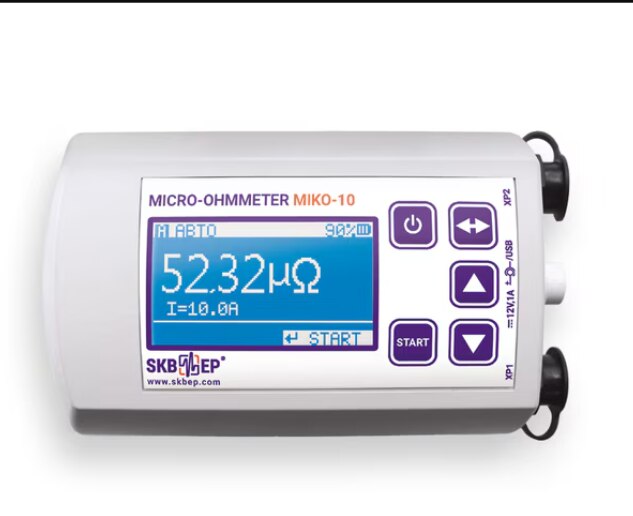
 | PRODUCTS MIKO-10 is ahead of similar instruments represented in the market due to a number of functional and technical features Test current up to 10 A... View product → |
Frequently asked questions
Which specifications matter in a compact micro ohm meter?
Check four-wire Kelvin measurement, test-current output, measurement range, accuracy, resolution, test duration, lead protection, battery operation and calibration documentation. A small display increment does not prove measurement accuracy.
How should you connect and test substation equipment?
Isolate, earth and discharge the equipment before connecting. Attach force-current leads across the joint, then place the sense-potential leads inside those contacts. Remove paint, oxidation and loose hardware from the test points, inject current, wait for a stable value and record the equipment identity and test current.
What does a reading mean, and which limit should you use?
The result represents the resistance of the tested current path after the four-wire method excludes lead resistance. Use the equipment manufacturer’s acceptance limit first, then compare all phases or parallel paths under the same conditions. Investigate a high value, a large phase-to-phase difference or an unstable result rather than applying a universal limit.
When is a compact 10 A meter enough for the job?
A compact 10 A meter is suitable when the equipment procedure specifies a 10 A test and the expected resistance, connection size and test duration fit the instrument’s rated range. Select a higher-current tester when the manufacturer requires it or when the joint needs greater current to reveal heating-related resistance.
What should you verify with a Mumbai supplier before ordering?
Ask for the datasheet, accuracy specification, 10 A duty rating, Kelvin lead-set details, calibration certificate, battery and charger information, delivery availability, warranty terms, repair arrangements and support for commissioning work in Mumbai.