

Rain, condensation, salt-laden air and dirty bushings can turn a sound transformer into a misleading test result during Mumbai’s wet season. You will be able to schedule the test, prepare the equipment, choose a safe voltage, interpret capacitance and tan delta together, and decide when a 12 kV tester is the wrong instrument.
Key takeaways
- Run the baseline before monsoon in dry, clean and thermally stable conditions.
- Keep bushings, terminals and test surfaces free from moisture, salt and contamination.
- Compare capacitance and tan delta with previous results, temperature and test connections.
- Repeat abnormal readings after drying and checking guards, leads, grounding and interference.
When to test transformer insulation before, during and after Mumbai’s monsoon
Run the baseline before Mumbai’s monsoon, during a planned outage in dry weather. A 12 kV capacitance and tan delta tester for monsoon maintenance in Mumbai is most useful when bushings, covers and terminals are clean, dry, thermally stable and free from salt deposits or standing water.
Postpone capacitance tan delta testing monsoon work when rain, visible condensation, wet surfaces, water bridging, unstable grounding or uncontrolled humidity prevents a dry, repeatable setup. Do not test immediately after washing.
Water on bushings or leads creates surface leakage, while an air-conditioned transformer moved into warm humid air can condense before its insulation and metalwork reach the same temperature. Use a sheltered area, controlled access and sufficient drying time.
- Before monsoon: schedule the outage, clean with the approved method, inspect coastal salt contamination, dry every test surface, record weather and humidity, and allow thermal stabilisation. This result becomes the comparison baseline.
- During monsoon: test only under shelter after rain has stopped and the equipment is demonstrably dry. Keep people away from flooded areas, and stop if grounding, clearances or access cannot be controlled.
- After monsoon: repeat the baseline setup once surfaces are dry and temperatures have stabilised. A changed capacitance or tan delta trend, phase imbalance or new instability can reveal moisture ingress, contamination or insulation deterioration.
- Document outage timing, weather, equipment temperature, cleaning, drying period, connections, repeat-test conditions and safe return to service. Monsoon conditions change environmental controls, not the underlying acceptance criteria.
What capacitance and tan delta reveal about a transformer’s insulation
Capacitance describes the insulation system’s measured geometry and dielectric response: how much charge it stores between conductors and ground. Tan delta, or dissipation factor, expresses dielectric loss relative to capacitive current. Moisture, ageing, degraded oil, contamination and temperature can increase loss; wet surfaces create leakage that distorts it.
Capacitance deserves equal attention. A sudden change can indicate altered internal geometry, winding movement, moisture-related dielectric change, a disconnected component or an incorrect connection. Record both values phase by phase.
| System | Connection | What it reveals |
|---|---|---|
| HV-to-ground | GST, with guard where applicable | High-voltage winding, bushings and insulation to the tank or ground |
| LV-to-ground | GST, with guard where applicable | Low-voltage winding and its insulation to ground |
| HV-to-LV | UST, with guard where applicable | Inter-winding insulation without including grounded paths |
A two-terminal test can combine these paths and hide a local defect. Use the manufacturer’s or utility’s procedure and IEEE 62.2 where applicable; repeat the same voltage, frequency, connections, lead arrangement and stabilization time. State the temperature-correction method, and record winding or insulation temperature, oil condition and the historical baseline.
For capacitance tan delta testing monsoon work, retain the stable final reading after settling, not the first display or an average of unstable values. Charging current, moisture redistribution, temperature drift and surface leakage can move the result.
In transformer insulation testing monsoon in Mumbai, trend, phase-to-phase differences and a sudden capacitance shift matter more than an isolated internet threshold.
A safe field workflow for a 12 kV tan delta test in wet weather
A 12 kv tan delta tester monsoon in mumbai job starts with a dry, controlled work area—not with the test lead. A 12 kv capacitance and tan delta tester for monsoon maintenance in mumbai must be used only after rain, condensation, wet surfaces, unstable grounding and water bridging are eliminated.
1. Issue the permit-to-work, isolate the transformer from the busbar and every external parallel path, apply lockout/tagout, prove dead, and install visible earths. Put barriers and controlled access around the test zone; maintain the manufacturer’s clearance distances from energised equipment.
2. Confirm the test object and configuration. Disconnect or treat cables, surge arresters, neutral links, capacitors and other windings as the procedure requires. Isolate CT secondary circuits safely. Connect the selected winding and bushing for GST, UST or guard measurement; never leave an attached cable or arrester to distort the result.
3. Inspect clean, dry test leads, stable earth connections, shielding and terminations. The 12 kV value is the instrument’s maximum AC output, not the transformer’s rating. Select a lower voltage when the manufacturer’s field procedure or applicable standard requires it.
4. Apply the source only after checking clearances. Record frequency, applied voltage, current, capacitance, tan delta, insulation temperature, humidity or weather notes, and stabilisation time. Reject unstable or noisy readings; do not average them away.
5. Remove the source, confirm discharge, apply earths, and earth the specimen before changing leads or configurations. Restore cables, arresters, links, CT circuits and covers, inspect the equipment, remove barriers under the permit, and release it only after return-to-service checks are complete.
Which assets a 12 kV tester can cover—and when it is unsuitable
A 12 kV output can test transformer winding-to-ground and interwinding insulation, bushings, CT and VT insulation, power cables within the equipment procedure, motors, and other grounded insulation systems. It is the tester’s maximum AC output—not the asset’s voltage rating.
| Asset | Suitable use | Stop or verify first |
|---|---|---|
| Transformer, bushing, CT or VT | GST, UST and guard measurements | Follow the manufacturer’s voltage and connection procedure |
| Power cable or motor | Tan delta and capacitance diagnosis | Confirm the cable or motor procedure permits the selected voltage |
| Low-voltage insulation | Use only the specified lower range | 12 kV can overstress insulation or violate the manufacturer’s limit |
Before procurement, check the voltage range, output current, frequency, capacitance range, GST/UST/guard capability, 50 Hz interference rejection, shielding requirements, noise or instability indication, and accuracy from pF to nF. Confirm whether attached cables, arresters, neutral links or capacitors must be disconnected.
12 kV is unsuitable when the manufacturer prohibits it, the insulation is low-voltage, or a different diagnostic test answers the question. Insulation resistance and PI, winding resistance, oil dielectric strength, dissolved-gas analysis, frequency-response analysis and partial-discharge testing expose different evidence; none replaces the others.
For a 12 kV tan delta tester monsoon in Mumbai, and transformer insulation testing monsoon in Mumbai, demand calibration date, traceability, uncertainty or accuracy, and the temperature, frequency, capacitance and interference conditions behind the guarantee. Myriad Industrial Solutions LLP can be evaluated as a Mumbai supplier only after its quoted instrument matches the procedure.
Related product
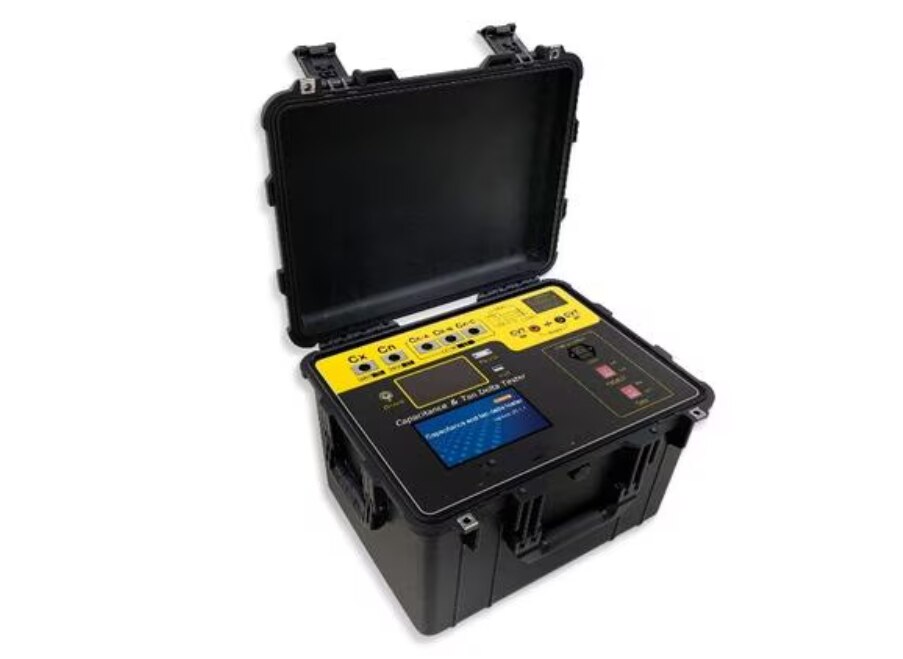
 | Transformer Testing instruments 12 KV Capacitance & Tan Delta Tester Capacitance and Tan Delta Tester is a very basic method in the insulation test, which can effectively find the overall moisture deterioration and... View product → |
How to troubleshoot a bad result before declaring insulation failure
Do not declare insulation failure from one unstable reading. Stop if the bushing, cover, terminal or lead is wet; clean salt and dirt by the approved method, dry the surface and leads, let the equipment reach a stable temperature, then repeat with the same configuration.
For capacitance tan delta testing monsoon work, check the setup before blaming the insulation:
- Verify the earth connection, guard continuity, lead routing, shielding, clearances and instrument range.
- Inspect for an open guard circuit, instrument-lead leakage, poor contact, loose termination, 50 Hz interference and unstable grounding.
- Confirm that an arrester, cable, neutral link, capacitor or other external circuit is not creating a parallel path.
- Where the procedure permits, perform a controlled connection check or lead-reversal check. Never alter connections on energized equipment; discharge and earth the specimen first.
| Result pattern | Likely concern | Next decision |
|---|---|---|
| One phase differs sharply | Local connection, surface leakage or insulation defect | Clean, reconnect and repeat |
| All readings drift or fluctuate | Interference, grounding or wet contamination | Stabilise the setup before judging |
| HV-ground, LV-ground and HV-LV all worsen | Internal insulation or oil condition | Correlate with other diagnostic tests |
Compare every phase and each connection with previous field and factory records after applying the documented temperature method. Transformer insulation testing monsoon in Mumbai requires the same diagnostic criteria, not a special limit. Pair the result with oil tests, DGA, insulation resistance or PI, winding resistance, frequency-response analysis and partial-discharge testing.
Report the original wet or unstable result; never hide it with an average.
Frequently asked questions
When should you test transformer insulation around Mumbai’s monsoon?
Run a baseline before the monsoon during a planned outage in dry weather. Test during the season only under controlled, safe outage conditions, then repeat after the monsoon to identify changes from moisture, contamination or ageing.
What do capacitance and tan delta reveal about transformer insulation?
Capacitance indicates changes in the insulation system’s geometry or dielectric condition. Tan delta measures dielectric losses; a rising value can indicate moisture, contamination, ageing or insulation damage when the test setup and temperature are controlled.
How do you perform a 12 kV tan delta test safely in wet weather?
Isolate, lock out and discharge the transformer, verify the absence of voltage, clean and dry the test points, establish an exclusion zone, connect the test leads and ground correctly, and stop if rain, condensation or standing water compromises the setup.
Which assets can a 12 kV capacitance and tan delta tester cover?
It can cover suitable transformer insulation systems, bushings, cables and other capacitive high-voltage assets within the instrument’s rated voltage, capacitance and test-current limits. Check the manufacturer’s manual before testing unfamiliar equipment.
What should you check before declaring transformer insulation failure?
Repeat the test after drying and cleaning the asset, confirm temperature correction and compare with historical results. Inspect lead routing, grounding, guarding, connections, surface leakage, electromagnetic interference and instrument status before concluding that insulation has failed.